
Blog
Should I vaccinate for rabies?

Rabies is almost always fatal once signs appear, and the vaccine decision is less about “indoor versus outdoor” than about what happens if a bat gets in. At Bizzy Bengals we learned that the hard way.
For a long time we treated rabies as a low-priority vaccine for cats that never leave the house. Many counties and clinics require it anyway. Where it is not required, a strictly indoor cat is lower risk than a cat that roams. However lower risk is not the same as no risk. Bats are the main reason. They are the most common source of rabies in much of the United States, and they do not need an open door. They slip into houses, garages, and most catios. Screen mesh that keeps a cat in will not always keep a bat out. A cat does not have to be bitten in an obvious fight. A bat on the floor, a paw swipe, or a queen carrying a stunned bat back to her kittens can be enough to count as exposure.
Any cat that goes outside unsupervised, even into a catio, should be vaccinated.
Why we initially held off on regular rabies vaccines for our cats
Cats are unusually prone to injection-site sarcoma, a rare but aggressive tumor that can form months or years after an injection. The risk is small, on the order of a few cases per 10,000 vaccines, but the tumors are difficult to treat. Adjuvants, the additives in many killed vaccines that amplify the immune response, drive more inflammation at the injection site and have long been the formulations most often linked to these sarcomas.
PureVax is the non-adjuvanted option. It is a recombinant canarypox-vectored vaccine: a harmless canarypox virus carries a rabies protein, so the cat’s immune system responds without a chemical adjuvant and without any risk of the vaccine causing rabies. Many feline-focused clinics use it specifically to lower injection-site inflammation. It comes in a one-year and a three-year label.
We recommend the PureVax 3-year non-adjuvanted vaccine. Every injection carries some sarcoma risk, adjuvanted or not, so the goal is not only to avoid the irritating additive but to poke the cat as rarely as the law and the label allow. After the initial series, a three-year non-adjuvanted product means one injection every three years instead of every year. A cheaper killed, adjuvanted rabies vaccine is not an equal substitute, and a one-year non-adjuvanted shot is only worth it if local rules will not accept the three-year label.
Whatever product is used, rabies should go as low as possible on the right hind leg, not between the shoulder blades. Watch the site. A lump that is still there at three months, larger than two centimeters, or growing after one month needs a vet, not a wait-and-see.
What a single escaped cat cost us
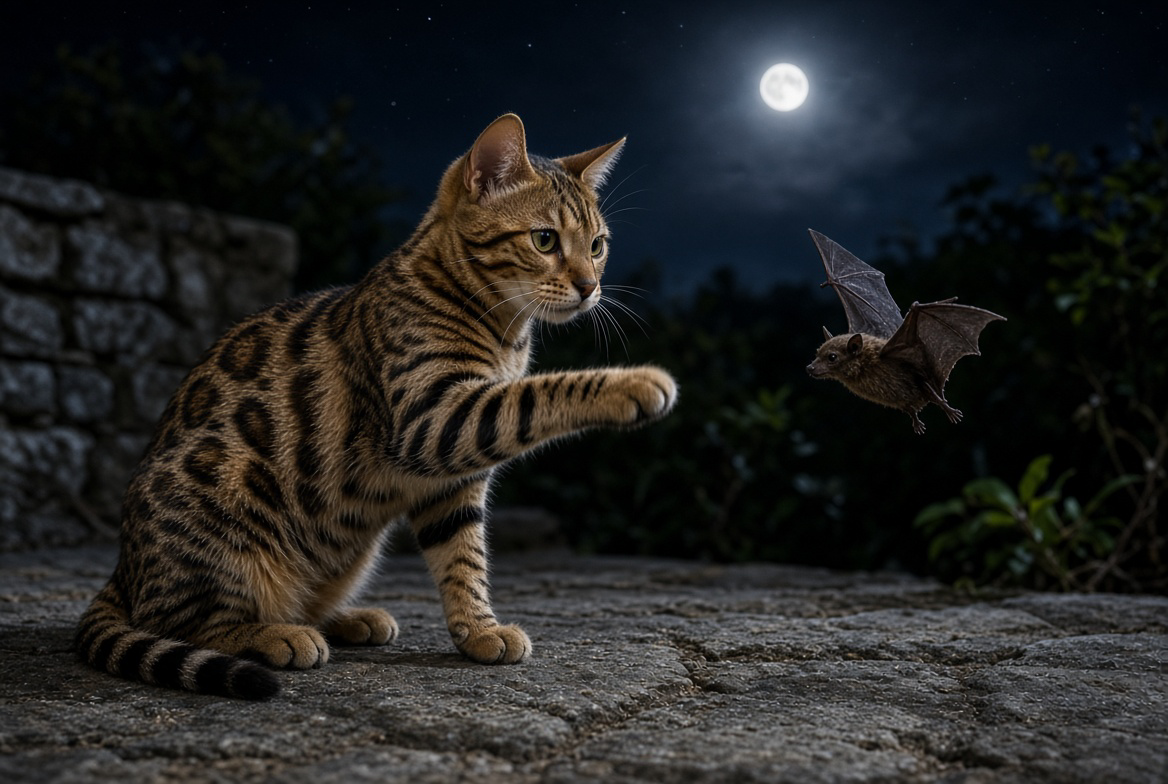
One of our indoor, unvaccinated queens got out. We found her tormenting a bat. There was no way to know whether she had been bitten or scratched, or whether she had carried virus back toward her litter.
We rushed her to the emergency clinic for an immediate rabies vaccination and called animal services about the bat. While the lab tested it, she and her entire litter were confined to one room. That hold lasted three days. Luckily, the bat was negative.
If it had been positive, or too damaged to test, the outcome would have been entirely different. Our local protocol would have kept her and the babies in quarantine for six months. Had she already been vaccinated and current, that same exposure would have meant a booster and about a month of observation instead of half a year of strict isolation. Three days of waiting on a lab result is manageable. Six months with a queen and a litter is not, and euthanasia is the other option public health often offers for a never-vaccinated animal after a confirmed exposure.
That scare changed our program. Low risk is not a reason to skip the vaccine.
If the cat is not vaccinated, do not wait.
Rabies has a long incubation period. In cats it is often measured in weeks to months, sometimes reported out to several months or longer, depending on the bite location and how much virus got in. That window is why vaccinating after a possible exposure still matters. An unvaccinated cat should be vaccinated as soon as possible, ideally within 96 hours. It is not a guarantee, and it does not replace quarantine, but it is still one of the most useful things you can do while the virus is traveling toward the nervous system and before any signs appear.
Once neurologic signs start, it is too late.
If the cat is already vaccinated
Current does not mean “skip the vet.” If you suspect contact with a bat or any possibly rabid animal, take the cat in within 48 hours for a booster even if the certificate is still valid. Sooner is better. Public health guidance generally wants that booster promptly, and a cat that is already vaccinated is then typically observed for a much shorter period, often about 45 days under the owner’s control, rather than months of strict quarantine. Local rules vary. Your veterinarian and animal control set the exact plan.
If you find a bat
Do not release it, and do not try to judge whether anyone was exposed. Call animal services or your local public health department immediately, especially if a person or a pet was in the same room, or if the bat was found where a child, a sleeping person, or a cat could have had contact.
If you are asked to hold the bat for testing:
• Keep the head intact. The test is done on brain tissue. A crushed skull can make the bat untestable, and an untestable bat is often treated as positive.
• Refrigerate it. Do not freeze it. Freezing can damage the brain and ruin the test.
• Do not leave it at room temperature.
• Do not handle it bare-handed. Heavy gloves, a container, and cardboard are enough if you must contain it until animal control arrives.
A negative test is the only result that cleanly ends the scare. Everything else becomes a quarantine decision.
We still hope none of our cats ever meets another bat. We no longer plan on that hope. A non-adjuvanted three-year rabies vaccine, given before there is an emergency, is one injection every three years against a disease that does not give second chances, and against a quarantine that can take a queen and her kittens out of a normal life for months.